Pest control software · Pricing breakdown
GorillaDesk pricing: what $49 a month actually buys a three-technician pest company
GorillaDesk publishes three tiers — $49, $99 and $149 a month — and bills per route rather than per user. For a residential pest company with three technicians, that means $147 a month on the cheapest tier, and $297 if you want the software to charge customer cards on its own. Here is how the numbers add up, read off the vendor's own pricing page on 8 October 2026.
Affiliate disclosure: some links on this page are affiliate links. If you sign up through one we may earn a commission, at no extra cost to you. It does not change what we recommend or how we rank it. Details here.
The short version
GorillaDesk's structure is simple and its published prices are low for what you get, but the headline $49 describes a company with one route. Three routes is $147. And two features that most residential pest companies eventually want — charging the customer's card automatically, and managing multi-unit properties — sit one tier up, so the number to plan against is closer to $297 a month than $147.
The tier you are really choosing between is Basic and Pro. If your customers pay by check or you invoice them and wait, Basic does the whole job, including the pesticide application record that state inspectors ask about. If you want the money to move on its own, you are on Pro.
At a glance
| Basic | $49/month or $539/year — estimates, invoices, work orders, recurring jobs, scheduling, materials tracking, Square/Stripe integration |
| Pro | $99/month — adds automatic subscription charging, customer portal, online booking, review requests, e-signature, multi-unit property management |
| Growth | $149/month or $1,639/year — adds map-based estimating, dynamic quote packages, sales pipeline, custom fields, multiple branches |
| Billing model | Per route, not per user. Three technicians on their own routes = three routes. |
| Three-technician company | $147/month on Basic · $297/month on Pro |
| Free trial | 14 days, no credit card |
| Setup fee | None found on the pricing page or in the trial |
| What we tested | Basic, in a free trial, 8–9 October 2026. Pro and Growth features were not tested. |
The published tiers, as they stood on 8 October 2026
These are the vendor's own numbers, read from GorillaDesk's pricing page. We do not quote aggregator prices, and prices change — check the page before you buy.
| Tier | Price | What it adds |
|---|---|---|
| Basic | $49/month or $539/year | Estimates, invoices, work orders, recurring jobs, scheduling, materials tracking, advanced invoicing frequency, Square/Stripe integration, reports |
| Pro | $99/month | Everything in Basic plus automatic subscription charging, the customer portal, online booking, review requests, e-signature, multi-unit property management |
| Growth | $149/month or $1,639/year | Everything plus map-based estimating, dynamic quote packages, sales pipeline, custom fields, multiple branches |
One honest note on the annual figures: $539 a year works out to $44.92 a month, so paying annually saves about $49 over twelve monthly payments. On Growth, $1,639 saves about $149. We did not buy an annual plan, so we are reading the discount off the price list rather than describing it from experience.
Per route, not per user — and why that matters
GorillaDesk charges by route. A route is roughly "one technician's day of stops", so a three-technician company where everyone runs their own work is three routes, whether or not the office manager also logs in. That is worth comparing against tools that charge per seat: at per-seat pricing, three technicians plus one office login is four seats.
The trade-off is at the small end. If you are a solo operator with a part-time helper you pay for two routes, and if you are a two-person crew riding together you are paying for one — which is the good half of this model.
What we could not verify: whether a route can be shared, reassigned, or left idle without being billed. We tested a single account, so we never saw an invoice with more than one route on it. Treat the three-route arithmetic above as the vendor's published model, not as an observation from a live bill.
The two gates that move the real price
1. Charging the customer's card is a Pro feature
On Basic you can put a customer on a recurring invoice and the software knows when to bill. It will not take the money. Automatic subscription charging — the customer's card on file, charged on schedule — sits in Pro at $99 a month.
For a company whose revenue is a quarterly contract renewed automatically, that is the difference between chasing payments and not. On the three-route example that is $147 versus $297 a month, so the real question is whether a part-time person chasing payments costs more or less than $150 a month. For most companies it costs more, which is why the price they should plan for is $297, not $49.
2. Multi-unit properties are also Pro
Our second test customer was a 24-unit apartment building, and multi-unit property management lives in Pro. If your book includes apartment complexes, HOAs, or commercial sites with several units, that gate applies to you as well.
One correction to our own first impression. Chemical tracking shows up in the Add-ons panel of the interface, which made us assume it was a paid extra. It is not — material logging is inside the $49 tier. We checked the pricing page before writing this, and we flagged our mistake in the review as well.
What the $49 tier really gives you
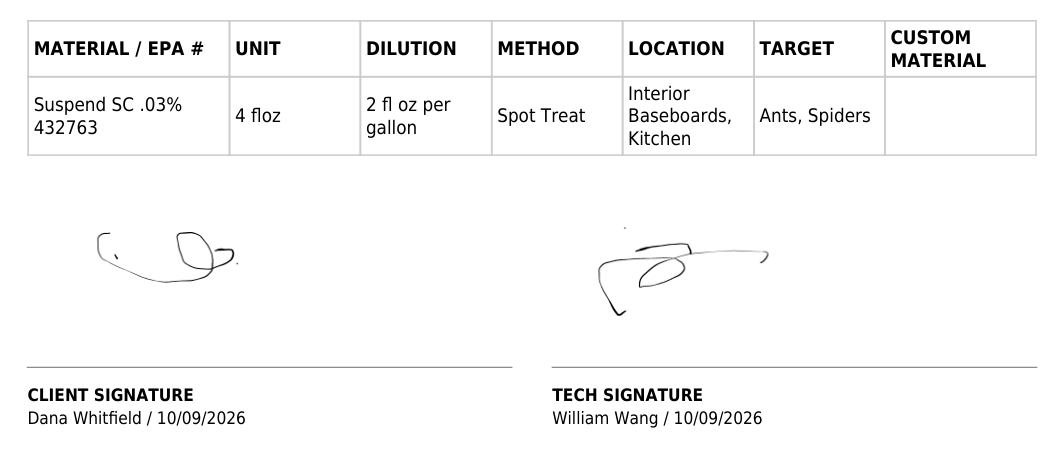
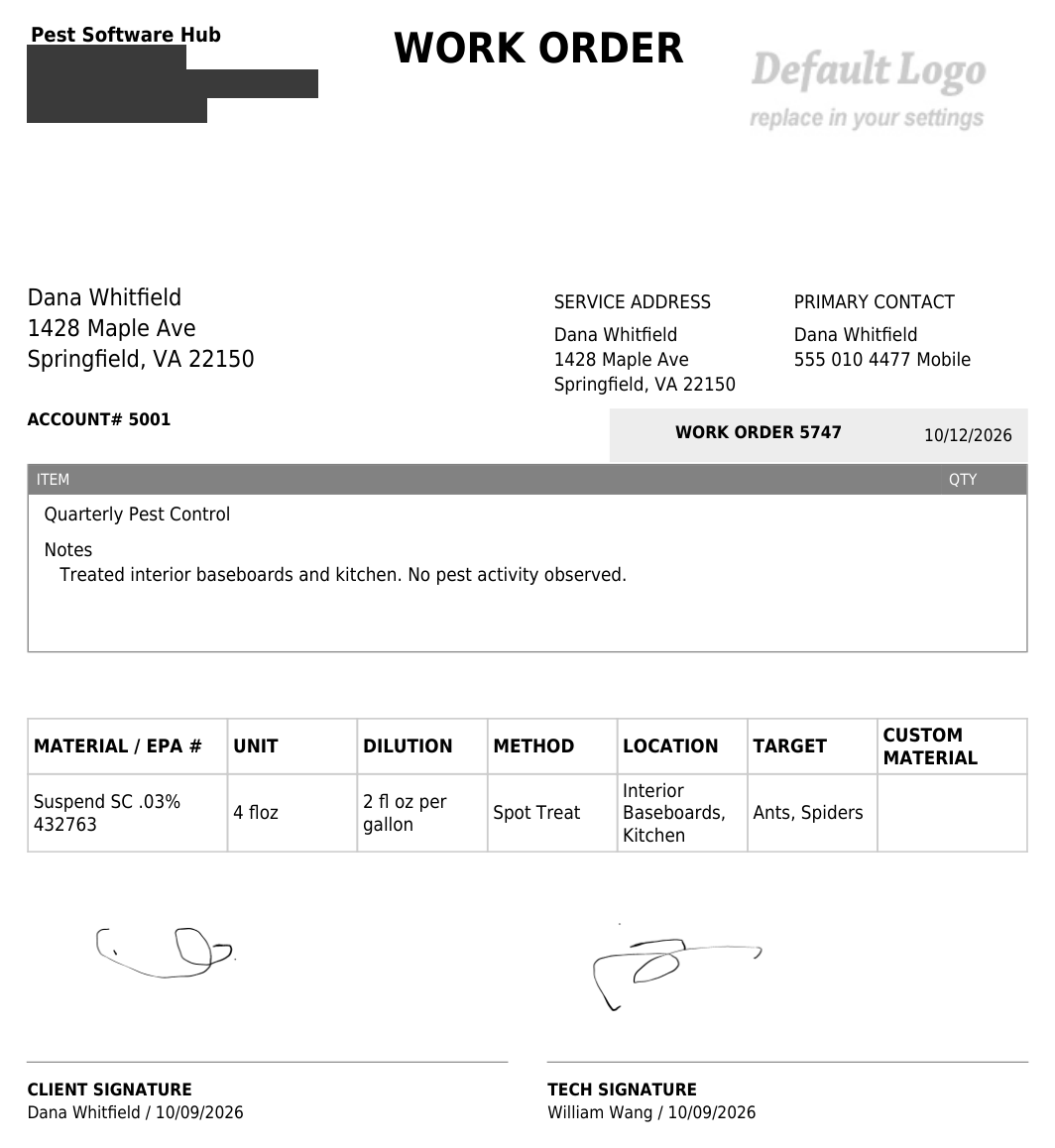
The cheapest tier is not a crippled version. It does the whole loop a residential pest company runs: quote, schedule, recurring visits, work order, invoice, record the payment, and log the pesticide application. The pesticide record is the part worth understanding before you decide, because it is the reason many pest companies pick this tool over a bigger general-purpose platform.
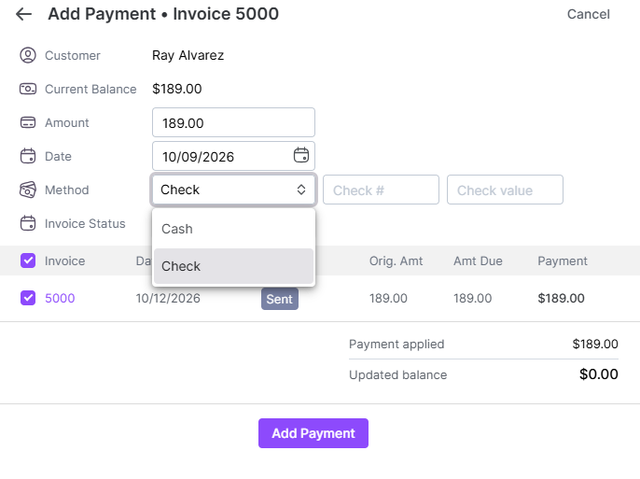
Two limits on the cheapest tier are worth knowing, and neither is on the pricing page. Offline payments can only be recorded as Cash or Check — take a Zelle transfer and you have to file it as one of those two. And the Reports menu in our trial listed 16 reports, while the pricing page advertises 20 for Basic. We are reporting both numbers rather than picking one; the difference may be tier-related or a page that has not been updated.
Costs the pricing page does not list
Three things showed up in the trial that a buyer should budget for.
The software picks a price before you do
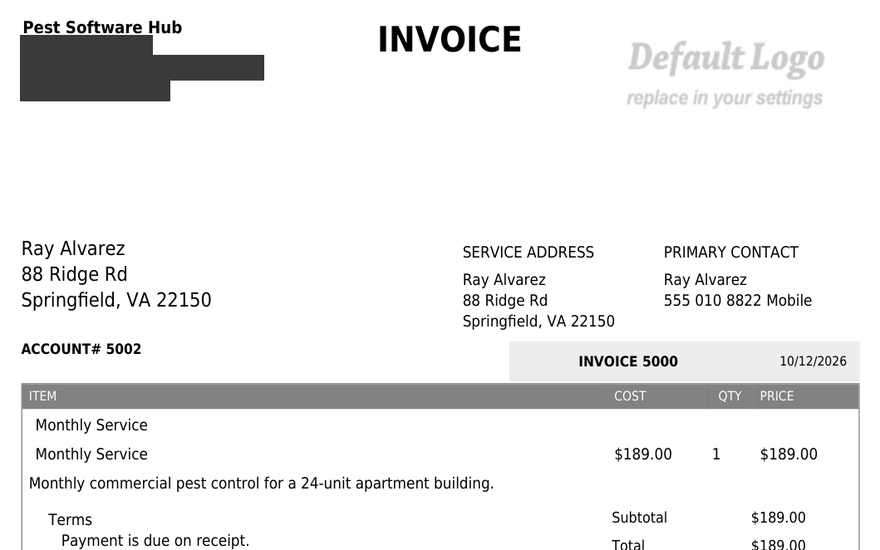
When we scheduled a monthly service, the account already contained a draft invoice for it, with a line item, a description and a price attached to the service preset. We changed ours to match our test data, but the sequence matters: the number arrived before we set one. If you send that draft without reading it, you have billed a customer an amount the software chose.
Card payments run through a separate system
GorillaDesk connects to Square or Stripe rather than processing cards itself, so card fees are whatever those providers charge, on top of your subscription. We did not connect a payment processor, so we cannot tell you anything about rates or settlement from experience — and any review that quotes you card rates for this product is quoting someone else's contract.
The trial caps customer emails
The trial runs 14 days and does not ask for a card, which is generous. It also stopped us sending the second customer email with "You've hit your free trial email limit." If evaluating the customer-facing side of the product is the point of your trial, plan the two messages you care about in advance.
Basic, Pro or Growth?
| If you are | Look at |
|---|---|
| One route, customers pay by check or bank transfer, no multi-unit sites | Basic. The pesticide record, recurring jobs and invoicing are all inside $49. |
| Any size, but you want cards charged automatically | Pro. This is the gate most residential pest companies hit. |
| Servicing apartments, HOAs or multi-unit commercial sites | Pro. Multi-unit management is Pro-only. |
| Running several branches or a sales pipeline | Growth. We did not test it, so we cannot tell you whether it is worth $50 more per route. |
Frequently asked questions
How much does GorillaDesk cost per month?
As of 8 October 2026: $49 for Basic ($539 a year), $99 for Pro, $149 for Growth ($1,639 a year). Billed per route.
What does a three-technician company actually pay?
Three routes on Basic is $147 a month. Three routes on Pro — which is what you need for automatic card charging — is $297 a month.
Is it priced per user?
No, per route. Each technician running their own route counts as one. An office login is not a separate seat, which is the useful part of this model.
Is chemical tracking included in Basic?
Yes. The product library, EPA registration numbers, dilution units, application methods, locations and target pests are all in the $49 tier. It appears in the Add-ons panel of the interface, which is misleading — we checked the pricing page before publishing.
Do I need Pro?
If you want customer cards charged automatically, yes. If you service multi-unit properties, yes. Otherwise Basic covers the whole residential route, including the pesticide documentation.
Are there setup fees, contracts or long commitments?
We saw none in the trial or on the pricing page. Annual billing is cheaper than monthly — about $49 a year cheaper on Basic, $149 on Growth — but we did not buy an annual plan and cannot describe the cancellation terms from experience.
What is not included in any tier?
Card processing fees, because those belong to Square or Stripe. And anything that depends on emailing customers during a trial, because the trial caps customer emails. Tracking technician hours is also not something this product does, which matters if you pay by the hour — we could not find check-in data anywhere in the reports.
Sources, and how to cite this page
Prices read from GorillaDesk's own pricing page on 8 October 2026. Behaviour observed in a free trial account (Basic tier) on 8–9 October 2026. Test data is fictional. Pro and Growth were not tested. We have not been paid by the vendor, and this page was not shown to the vendor before publication.
Cite this page: Wang, William. "GorillaDesk pricing: what $49 a month actually buys a three-technician pest company." Pest Software Hub, 10 October 2026. https://pestsoftwarehub.com/gorilladesk-pricing
Corrections: if a price here does not match what you see at checkout, tell us and we will check it and publish the fix with the date.
Related reading
- GorillaDesk review — the same scripted route run end to end, with the screenshots to match
- GorillaDesk vs Jobber for pest control — where each one wins, and what they both get wrong
- How we test, and what we can't — including why we do not quote stopwatch setup times