Pest control software · Pricing across the market
Pest control software pricing: what you can see without a sales call
For a three-technician pest company running three routes, the two prices we could actually get our hands on were $147 a month on GorillaDesk's cheapest tier and $149 a month on Jobber's, billed annually with five users included. If you want the software to charge customer cards on its own, that becomes $297 against $149. Those two vendors are also the only ones of the six we tried that let a small company in without a credit card. The other four either publish no number, start the trial from a card, or check where you live and who your phone number belongs to.
Affiliate disclosure: some links on this site are affiliate links. If you sign up through one we may earn a commission, at no extra cost to you. It does not change what we recommend or how we rank it. Where a page carries an affiliate link, the link is labeled where it appears. Details here.
The short version
Pricing in this category is not hidden on purpose so much as priced on a call. Three of the six vendors we looked at publish no number at all, and one of them says plainly that it does not offer a free trial. That is a real business model, and it is also why the numbers you find on comparison sites disagree with each other: the price here moves with team size, route count, active customer count and how long you commit for, and most lists don't say which of those they used.
What we can do is tell you the small number of prices a three-technician shop can reach today, name the walls that stop you reaching the rest, and separate the billing models that decide your real monthly figure — per route, per user with an allowance, per field user, per seat, or per active customer. Then the question stops being "which is cheapest" and becomes "which model punishes my shape of company least". If you are still narrowing the field rather than pricing it, the six questions are the better place to start.
One thing we will not do: put a number on a vendor we could not get into. Where we only know what a vendor's own page says, it is attributed and dated, and where we know nothing, the table says so.
At a glance
| Three routes, cheapest tier | GorillaDesk $147/mo · Jobber $149/mo billed annually, five users included at the 2–5 person team size |
| Three routes, card charging included | GorillaDesk $297/mo (Pro) · Jobber $149/mo (Connect) — the capability sits on its cheapest plan |
| Vendors publishing a price | GorillaDesk · QuoteIQ · Housecall Pro on their own pages · Jobber only inside the account |
| Vendors publishing no price | PestPac · Briostack · FieldRoutes |
| Trials without a card | GorillaDesk (14 days) · Jobber (states "No credit card required") |
| Billing models seen | Per route · per plan with users included · per active customer · per-user tiers |
| Card processing | Jobber: 2.9% + 30¢, identical on all three plans · GorillaDesk: through Square or Stripe, so the provider's rates |
| What we could not get | Any number from PestPac, Briostack or FieldRoutes · any plan we bought or invoice we received |
The two prices we can give you
Both of these came from the vendors themselves — one from a public pricing page, one from a screen inside our own account. We state the date, and for Jobber we state the two settings that changed the answer.
GorillaDesk: $49, $99, $149 — billed per route
Read from GorillaDesk's pricing page on October 8, 2026: Basic $49 a month ($539 a year), Pro $99 a month, Growth $149 a month ($1,639 a year). The billing unit is a route, not a person, so a three-technician company where everyone runs their own work is three routes — $147 on Basic, $297 on Pro.
The tier that matters is the step from Basic to Pro, and it is not about features in the abstract. Automatic charging of a customer's card sits in Pro, and so does multi-unit property management. If your quarterly contracts renew on a card on file, the number to plan against is $297, not $147. We wrote that arithmetic out in full on our GorillaDesk pricing page, including the part we could not verify: whether a route can be shared, parked or left idle without being billed.
GorillaDesk in one line: 14-day trial with no card, cheapest tier carries the pesticide application record, and card charging is the feature that pushes you up a tier. GorillaDesk's own site. What the account is actually like is here.
Jobber: three prices per plan, depending on what you commit to
Jobber's pricing page does not put its numbers in the page source, so we read them off the plan screen inside our own trial account on October 11 and 12, 2026. The billing control above the cards is the part worth understanding: it is not a discount switch, it is a choice between three levels of commitment, and each has its own price.
| Plan | No commitment (month to month) | 12-month minimum (billed monthly) | Annual, prepaid |
|---|---|---|---|
| Connect | $199/mo | $169/mo | $149/mo |
| Grow | $299/mo | $259/mo | $229/mo |
| Plus | $499/mo | $439/mo | $399/mo |
Every plan at this team size includes five users, and the allowance grows to ten and then fifteen if you move the team-size selector up — the price moves with it. A user above your plan limit is $29 a month, charged from the time you buy. And the three arrangements are not the same product sold three ways — they carry three different levels of risk. Month to month with no commitment cancels any time. Month to month on a 12-month minimum keeps billing you if you cancel early, all the way to the end of the year. Annual prepaid is billed up front and is non-refundable if you leave mid-term.
Over a first year, choosing annual instead of no-commitment saves $600 on Connect, $840 on Grow and $1,200 on Plus. That is the size of the bet you are making on the product, and it is why the trial matters more than the price list.
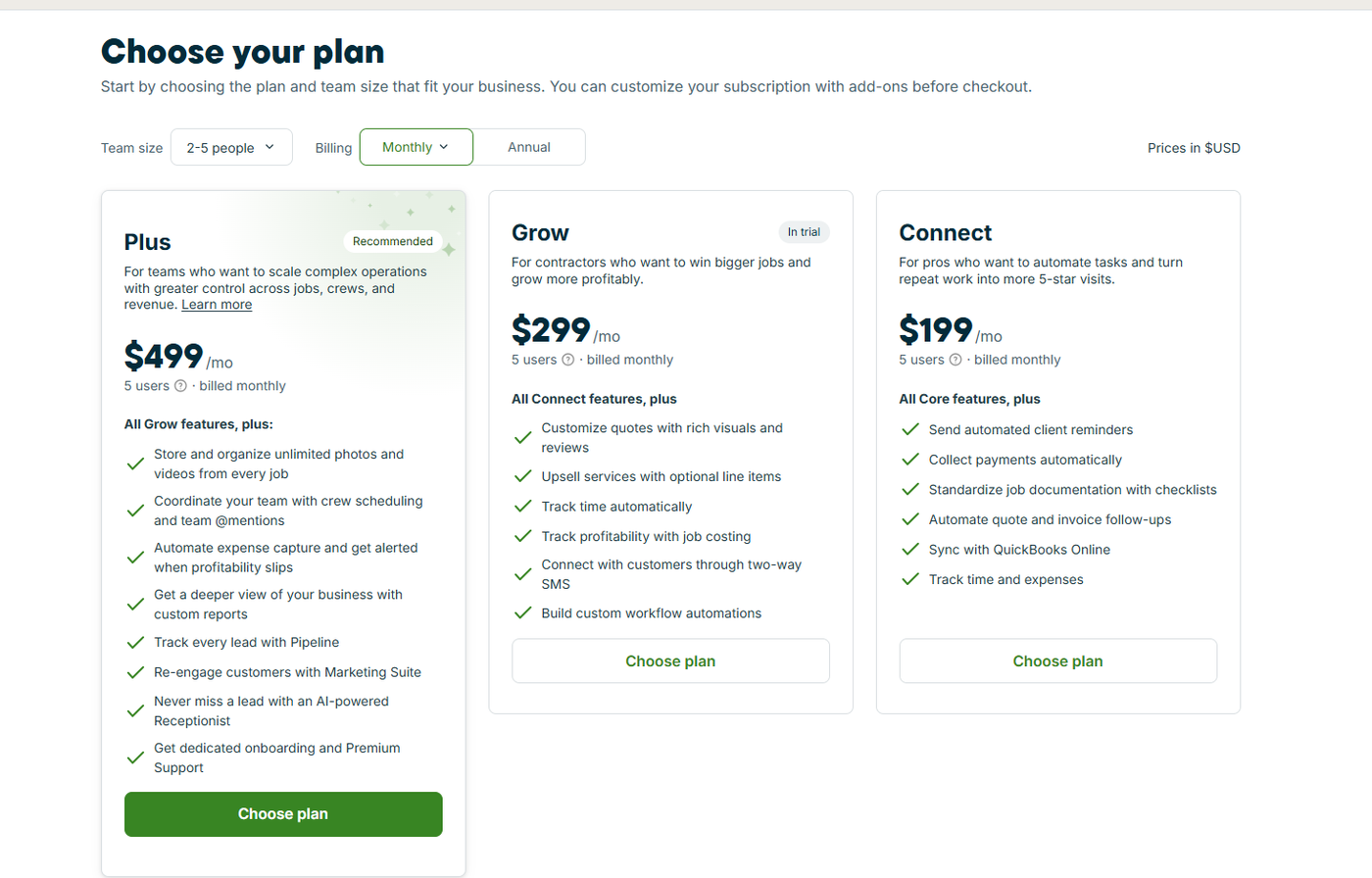
Jobber in one line: the highest starting price of the two we could test, and the only one of the six whose public pricing page keeps its numbers out of the page source — you see them once you are inside an account. Jobber's own site.
If you want to start the trial, the signup is here — an affiliate link, we earn a commission if you become a paying customer, and referred accounts are eligible for 20% off for the first six months. Jobber’s own site if you would rather go direct.
Why everything you read about Jobber's price is different
Before we got into the account, we were reading $39 in one place and $139 in another for the same product. Once inside, we understood why: the plan screen recalculates on team size and on the billing commitment, so "the price" is not a fact until you say which company you are and how long you are signing for. A list that gives you one number without those two inputs has picked them for you, usually without saying so.
That is also the honest limit on our own numbers. Ours describe a 2-to-5 person team on annual billing, captured on October 11 and 12, 2026 — three technicians and an office login. The screen carries four team sizes in total, and the same Connect plan runs $99 at a one-person shop and $299 at fifteen people or more, so read the row that matches your headcount rather than ours. We published all four on our Jobber pricing page.
Five vendors, four different walls
This is the part that costs a small company the most time, because unlike a price, a wall is invisible until you walk into it. Each of these was checked on October 12, 2026 by trying to find a number or start an account.
PestPac: pricing by consultation
PestPac's pricing page lists three packages — Small Business, Professional and Enterprise — with feature bullets and no prices. The sentence that stands in for the numbers is this one, quoted from that page: "Speak with a consultant today for more information on pricing packages and to build a package best suited to your needs." There is no self-serve signup and no trial link.
FieldRoutes: no price, and no trial by design
The pricing page lists two packages, Growth and Corporate, each with a Request Pricing button instead of a figure. Its own FAQ answers the trial question directly: "FieldRoutes does not offer a free trial because of the software's highly customizable nature." The same FAQ states that the monthly subscription is based on the number of active customers — a third billing model, and one that a growing company should read twice, because your bill rises as you win work.
Briostack: no price on the page we read
We found no figure on Briostack's homepage, no self-serve signup and no trial offer; the calls to action we saw were Explore and Learn More, and the pricing URL we tried returned a 404. This is the weakest of our four entries, and we are labeling it as such: a missing page in a URL we guessed is not the same as a vendor that publishes nothing. What we can say is that a small company landing there has no path to a number without contacting someone.
Housecall Pro: the price is public, the door is not
Housecall Pro publishes prices, and we could not get in to test them. Its terms limit the service to residents of the United States and Canada, and the signup form validates a real US or Canadian mobile number. That is a legitimate restriction and it is also the end of the road for us — we do not fake a phone number to get past a check. If you are reading this from outside North America, that wall is worth knowing about before you spend an afternoon on the form.
QuoteIQ: the price is public, and public twice, in two versions
QuoteIQ publishes a price list: $29.99, $99.99, $199.99, $299.99 and $699.99 a month, with the tiers defined by how many users you get — one, two, four, ten and twenty — and $25 per additional user per month on every plan, which is what turns its cheapest tier into a three-user decision rather than a one-user one. We could not publish a review of the product to go with those numbers, and our testing log says why. The full breakdown, including the trial terms, is on its own page.
Its trial is where the wall is. QuoteIQ's own FAQ describes the 14-day trial as running from a plan selection, its payment methods are cards through Stripe, and its plan buttons read Subscribe with no card-free entry. We stopped at that point and did not bind a card. Logging in without one puts you in a free workspace, and in that state we could not create a client or a job — the software answered every attempt with a message asking us to upgrade. So the honest summary is: QuoteIQ shows you a price, and without a card you cannot test the thing the price buys.
| Vendor | Price you can read | Trial without a card | The wall |
|---|---|---|---|
| GorillaDesk | Yes, published | Yes, 14 days | None for us. Card charging is a tier up. |
| Jobber | Yes, in the account | Yes | None for us. Nothing published on the site. |
| QuoteIQ | Yes, two versions | No | Trial starts from a plan and a card |
| Housecall Pro | Yes | Not reached | US and Canada only, real phone number required |
| PestPac | No | No | Pricing by consultation |
| FieldRoutes | No | No, by their own FAQ | Request Pricing; demo only |
| Briostack | None found | None found | No self-serve route found |
Read that table as a shopping list rather than a verdict. Publishing no price is a choice a vendor is entitled to make, and for a company with forty routes and a procurement process it may cost nothing at all. For a three-person shop comparing options on a Sunday evening, it removes three of the biggest names in the category from the shortlist before the first call.
The billing model matters more than the tier
Six vendors, six different units of charge. This is the decision that survives after you have forgotten which plan you picked.
| Model | Who uses it | What it means for a three-technician shop |
|---|---|---|
| Per route | GorillaDesk | You pay for 3 routes — $147 on Basic, $297 on Pro. An office login is not a separate charge. One technician doubling up on a second route costs you. |
| Per plan, users included | Jobber | Users come bundled into team-size bands. At a 2–5 person headcount that is five users and $149 a month billed annually; the allowance rises to ten and fifteen as the band moves, and the plan price moves with it. |
| Per field user | Fieldwork | $59, $79 or $99 for each field user per month, with "Office User Free" printed on all three plans. Three technicians is $177 on the cheapest tier. |
| Per active customer | Pocomos, and FieldRoutes per its own FAQ | Your bill grows as you win work rather than as you hire. Pocomos publishes tiers: $99 up to 20 active customers, $159 to 50, $209 to 300 and $275 to 500. |
| Per seat tiers | QuoteIQ | Tiers defined by seat count — 1, 2, 4, 10 and 20 users — with $25 a month for each additional seat, on every plan. |
| Per job | ServiceM8 | You pay for visits, not people. $29, $79, $149 and $349 a month buy 50, 150, 500 and 1,500 jobs, and every paid tier carries unlimited users — so hiring is free and volume is not. A quarterly contract is four jobs a year however many technicians carry it. |
The trap in the per-route model is at the small end, and the trap in the per-user model is at the office end. A three-technician company that hires a part-time office manager is free on one model and costs money on the other. Nothing on a pricing page tells you this; you work it out from the billing unit.
What sits on top of the subscription
Card processing is the line item that decides more of your real monthly cost than the subscription does, and it is the one nobody publishes. We found Jobber's rates inside the account, on the feature-comparison table, and they are the same on all three plans: 2.9% + 30¢ for card payments, 2.7% + 30¢ for tap to pay, and 1% for ACH.
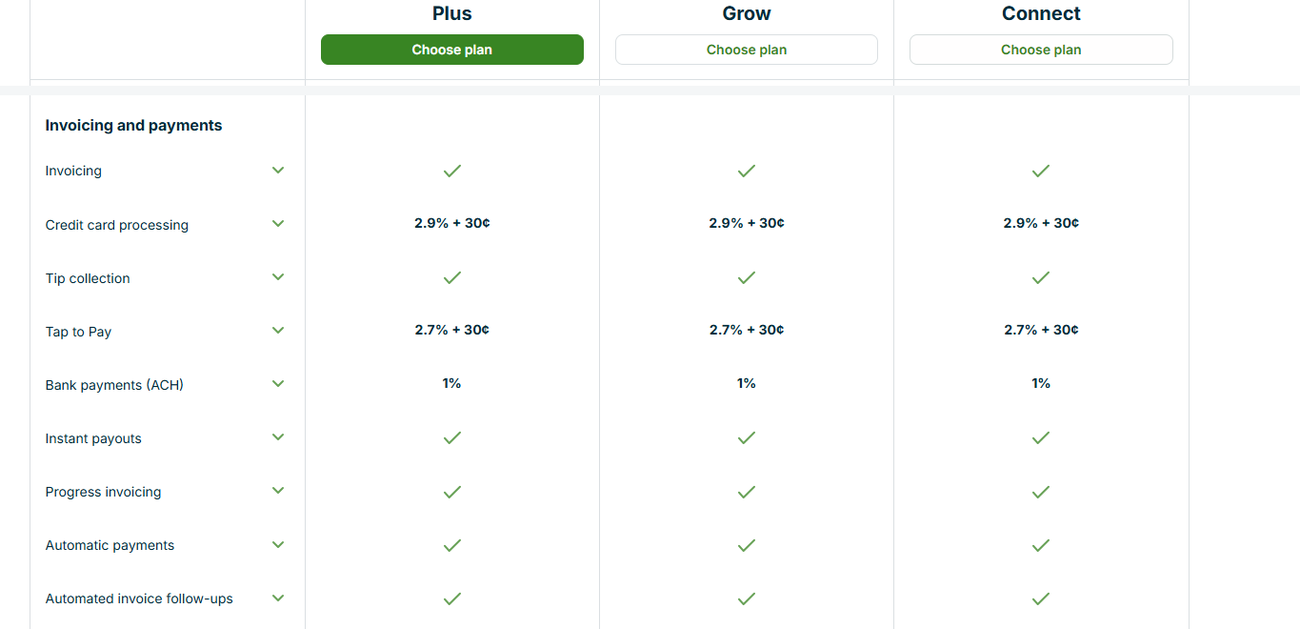
GorillaDesk is the opposite arrangement. It does not process cards itself; it connects to Square or Stripe, so the rate belongs to whichever of those you already use or open. We did not connect a processor in either product, so we have never seen a settlement, and any review that quotes you card rates for a pest tool is quoting a contract they signed, not one you will get.
The other thing that sits on top is the feature a tier holds back, and this is where the gap between the two tested vendors was widest. On GorillaDesk, automatic card charging is what moves you from $147 to $297. On Jobber, collect payments automatically is listed on Connect — the $149 plan, the cheapest of the three we were shown. Two vendors, two prices for the same capability, and a difference in what else each one does that no price list resolves.
Two smaller lines we would budget for because they showed up in testing rather than on a price list. Add-ons: Jobber's Receptionist, an AI phone answering service, was advertised inside the same account at $99 a month for 50 conversations, and Jobber's Plus plan also lists an AI receptionist among its own features — we could not work out whether Plus includes conversations or none, and we are not going to guess at someone's contract. And limits: GorillaDesk's trial is generous with time and no card at all, but it caps the customer emails you can send, so one of the two messages we wanted to test came back with a request to upgrade. Anything that depends on emailing a customer cannot be fully judged on that trial.
Pricing it for your own shop
Here is the arithmetic for the company we actually ran through all three products: three technicians, three routes, roughly 200 residential accounts, mostly quarterly contracts. Two scenarios, because the second one is where most companies land. If your company is a different shape, the calculator puts your own headcount and customer count through all six billing models.
| If you | Budget |
|---|---|
| Invoice customers and wait for payment | GorillaDesk Basic, $147/mo — three routes, pesticide application record included, recurring contracts included |
| Want cards charged automatically, and need pesticide records | GorillaDesk Pro, $297/mo — the tier that charges cards and manages multi-unit properties |
| Want cards charged automatically, and can live with the application record being entered at a desk | Jobber Connect, $149/mo billed annually at this team size — five users, automatic collection on the cheapest plan offered here, and a Chemical Tracking module that cannot be filled in from the phone |
| Want job costing as well as automatic charging | Jobber Grow, $229/mo billed annually — and read what we found about which jobs actually appear in its profit view before you pay for it |
| Want the lowest bill and can keep the record outside the software | ServiceM8 Growing, $79/mo — 150 jobs covers a 200-account quarterly book at about 67 jobs a month, with unlimited users; there is no native pesticide application record |
A year on GorillaDesk Basic is about $1,764, and a year on Jobber Connect is about $1,788 before processing fees — within twenty-five dollars of each other. A year on ServiceM8 Growing is about $948, which is where the spread actually is. But the deciding factor here is not money at all: it is whether the state paperwork has to live inside the software or can live in a second system. That is the question this whole category dances around, and it is the one we would answer first.
What we could not verify: we never bought a plan, never connected a payment processor and never received an invoice from any vendor, so no money moved and every figure above is a price list rather than a bill. We did not test GorillaDesk's Pro or Growth tiers. We have never logged into PestPac, Briostack, FieldRoutes or Housecall Pro, so everything about those four comes from their own public pages on the date stated, and "we found no price" means exactly that and not "there is none". And the route and user arithmetic is the vendors' published model, not something we have seen on a real statement.
Frequently asked questions
How much does pest control software cost for a three-technician company?
The two prices we verified were $147 a month for three routes on GorillaDesk Basic, and $149 a month on Jobber Connect billed annually with five users included at that team size. Add automatic card charging and GorillaDesk becomes $297, because that capability is in Pro. Jobber includes it on the cheapest plan offered at a 2–5 person team size, and both its price and its user allowance rise if your headcount moves into another band.
Which vendors publish their prices?
GorillaDesk, Jobber, QuoteIQ and Housecall Pro, in different degrees — Jobber shows you numbers only after you are inside an account. PestPac, Briostack and FieldRoutes published none that we could find on October 12, 2026.
Can I try any of this without giving a credit card?
GorillaDesk yes, 14 days. Jobber's registration page states no credit card required. QuoteIQ's trial starts from a plan selection with cards only, and without a card we could not create a client or a job. We did not reach the signup step on Housecall Pro because of its residency and phone requirements.
Per user or per route?
Both exist, and the difference shows up when your headcount changes. GorillaDesk charges per route, so an office login is free and a second route costs money. Jobber bundles five users at a 2–5 person team size and charges $29 for each user above the plan limit, but both the allowance and the price step up as you select a bigger team size — ten users at 6–10 people, fifteen at 11–15+, and the same Connect plan goes from $149 to $229 to $299 a month billed annually. QuoteIQ defines tiers by seat count and charges $25 per additional user in its own documentation. FieldRoutes says its subscription is based on active customers.
What else will I be paying for?
Card processing first. Jobber's own table lists 2.9% + 30¢ for cards, 2.7% + 30¢ for tap to pay and 1% for ACH on every plan. GorillaDesk hands card payments to Square or Stripe, so you pay their rates. Add-ons second — Jobber's Receptionist was $99 a month for 50 conversations. And if you commit annually, remember that Jobber's annual prepayment is non-refundable mid-term.
Why is every published price different?
Because the price in this category depends on inputs the lists rarely state. Jobber's own screen produces three different prices for the same plan depending on what you commit to, and more than one for the same plan depending on team size. We looked at published lists ranging from $39 to $149 for a product that quoted us $149 to $399. If a number does not come with a team size and a billing term, it is not a price, it is an average.
Does anyone price this by how many customers you have?
FieldRoutes states in its own FAQ that the monthly subscription is based on the number of active customers. That is a real alternative to per-route and per-user pricing, and it behaves differently: your bill rises as you grow, which is fine if revenue rises faster, and uncomfortable in the month you win a big account and haven't collected on it yet.
Sources, and how to cite this page
GorillaDesk prices read from GorillaDesk's own pricing page on October 8, 2026; behavior observed in a free trial (Basic tier) on October 8–9, 2026. Jobber prices read from the plan screen and feature-comparison table inside our own trial account on October 11, 2026, with the team-size selector on 2–5 people and annual billing selected; behavior observed October 9 and 11, 2026. QuoteIQ figures read from its public pricing page and from screens inside its free workspace, September–October 2026. PestPac, FieldRoutes and Briostack statements quoted from their own public pages, read October 12, 2026. Housecall Pro described from its published terms and its signup form. No vendor has seen this page, none has paid us, and no vendor has been given the chance to correct it before publication.
Cite this page: Wang, William. "Pest control software pricing: what you can see without a sales call." Pest Software Hub, October 12, 2026. https://pestsoftwarehub.com/pest-control-software-pricing
Corrections: if a price here does not match what you see at checkout, or if a wall we describe has come down, tell us and we will check it and publish the fix with the date.
Related reading
- Is there a free plan? — what $0 gets you at four vendors, and where the real floor sits
- ServiceM8 pricing — the ladder behind the $79 figure
- The products behind these prices — what each one actually did on a pest route
- Cost calculator — your own headcount and customer count, put through all six models
- How to choose pest control software — the six questions, and the trial walls
- QuoteIQ pricing — the vendor whose price we could read most easily and trust least
- GorillaDesk pricing — per route, in full
- Jobber pricing — four team sizes, three billing commitments
- ServiceM8 recurring jobs — the 4-week cap on quarterly routes, from our own trial